Animal Stories - People Talking About Birds


Animal-World info on Zebra Finch
Animal Story on Zebra Finch
List Animal Stories on Zebra Finch
More info at Animal-World
gill - 2013-04-01
my male zebra finch wont let my female finch inside the nest. when she gets close all he does is scare her away and chase her for a bit. what should I do. this all started after she laid her 3rd egg, she now has 4.

Reply
Animal-World info on Stafford Canary
Animal Story on Stafford Canary
List Animal Stories on Stafford Canary
More info at Animal-World
Andrew Siddell - 2013-03-31
Will a lone stafford canary live out doors as i saw one flying about this easter

Click For Replies (1)
  • Jeremy Roche - 2013-04-01
    They can depending on environment.
Reply
Animal-World info on Lizard Canary
Animal Story on Lizard Canary
List Animal Stories on Lizard Canary
More info at Animal-World
Milla - 2013-03-30
Are these little guys (lizard canaries) good house pets? /: (; Are they nice to children? And do lizard canaries have a beautiful singing voice?

Reply
Animal-World info on Black-headed Caique
Animal Story on Black-headed Caique
List Animal Stories on Black-headed Caique
More info at Animal-World
Milla - 2013-03-29
I have read a few of your comments and see some of you have got a caique so you must know alot about them. Iam intreseged in buying a bird,maybe a caique,so i have a few questions for you: Do caiques sing at night? Or do they sleep? Do they need alot of care, including playing?

Reply
Animal-World info on Plum-headed Parakeet
Animal Story on Plum-headed Parakeet
List Animal Stories on Plum-headed Parakeet
More info at Animal-World
Prateek - 2013-03-29
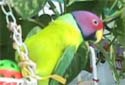
I have an infant Plumhead.... hardly 2-3 weeks old. Is anyone familiar with handling such small ones? Would u please tell me how to take care of these birds at this starting age, regarding diet, hand feeding, enclosure, training etc...???

Reply
Hadi - 2012-03-01
Hi, I have one pair of plum headed parakeets.
I have some questions:

1.One of males eye has problem and is closed! What should I do?
2.How big a cage should they be in?
3.How can I train them?

Click For Replies (4)
  • Charlie Roche - 2012-03-01
    Eye closed? This could be an injury but it could also be an allergy. If it is an allergy, the eye(s) should eventually be fine. If it is an injury - you might went to check it and wash with warm water. You could put just a little dab of vaseline on the eye border. Train them? If you have a pair, they are just going to do what they wish to do. It would be very difficult to train them - even to just 'step up' as they will bond with each other. Housing requirements, check out this article on Animal World Parakeet Housing
  • Charlie Roche - 2012-05-10
    No, they do not tolerate cold temperatures or even extremely hot but definitely not cold.
  • Tracy - 2012-05-09
    You might need to take your bird into the vet about the closing of it. I don't know but do you know how rare these birds are? you should have them in a flight cage or avary with lots of space to fly around and If you had their wings clipped professionaly and then handled them about an hour every day it will not take anytime to train these birds. Have they layed eggs yet? They are hard to breed in captivity. there is a few tricks I could teach you if your are going to breed them. Let me know.
  • Pegasus - 2013-03-29
    I have an infant Plumhead.... hardly 2-3 weeks old. Are u familiar with handling such small ones? Would u please tell me how to take care of these birds, regarding diet, hand feeding, enclosure, training etc...???
Reply
Animal-World info on Lutino Lovebird
Animal Story on Lutino Lovebird
List Animal Stories on Lutino Lovebird
More info at Animal-World
ananya roy - 2013-03-27
Hi, one of my lutino lovebirds has his/her 'V' shaped breast bone quite visible. The bird eats normal, his/her droppings are normal but she/he sleeps all the time or dozes perching on the nest box. The bird stays puffed up, although it is quite hot here in india, but when he/she sees me (or any other person) coming,he/she jumps down and disappears into the nest. The birds are about 2 years old (as told by the store keeper). I have seen them doing 'it' many times. This bird's partner's head is evenly shaped, I mean has a round appearance while joining with the neck, but this one has an uneven curve, it's head has an edge and then comes down to join with the neck. There is no scope of DNA sexing here. So I tried to visually sex them. The bird in concern plays with his/her mate and continuously begs for food, and the partner feeds it. I offered cuttle bone, mashed eggs and sweet potatoes but they didn't like those. Is the bird ill? My lutinos are very lazy by nature. They stay in the nest most of the time, sleep and take naps. The only time they are super active is when I change their water and give them fresh food. I feed them seed-mix, pearl millet and mix a little vitamin tonic in their water twice a week. I am very concerned for my bird. (The vet was of no help and there is no reliable avian vet in our area)  So please help me and respond ASAP. I don't want to lose my bird. Ananya

Click For Replies (1)
  • Jasmine Brough Hinesley - 2013-03-29
    Yes, it sounds like the birds have some sort of malaise. Lovebirds are very active, and constantly preening one another. This description is a strong indicator of illness and I would suggest taking the birds to an avian veterinarian for diagnosis. The vet will also want stool samples. If you cannot find a vet you can try adding tetracycline to their drinking water to help if it’s a bacterial infection. Also occasionally adding probiotics (beneficial bacteria – different countries have different brand names) can help. It helps restore beneficial bacteria to the parrots gut helping to counter a yeast infection. Some also say a few drops of organic apple cider vinegar to the drinking water can help with yeast infections as well.  But without knowing what the problem is, these are just possible helps.

    As far as pairing, it is very difficult to sex lovebirds visually and physically. Lovebirds are extremely social. They will preen and exhibit a very close bond with another same sex friend just as they will with a bird of opposite sex. Some basic sexual differences are the pelvic bones of the female are slightly wider spaced than on the male. Also the female will tend to hunch down on the perch more than the male, with her feet wider spread, while the male will tend to stand more upright. But to be certain of sex however, it is best to have an experienced breeder sex them . A sure indication that you have a male/female pair is getting fertile eggs.

Reply
Animal-World info on Zebra Finch
Animal Story on Zebra Finch
List Animal Stories on Zebra Finch
More info at Animal-World
arno - 2013-03-29
Hi I had two zebra finches male and female I bought me a new pair yesterday but this morning I noticed there was one egg in the old nest both females and one male slept in the old nest how must I know who's egg is it cuz my old pair is building a new nest in the new nest I bought with the pair yesterday the egg is in the old nest what must I do please please please help me my email is arnoleroux15@gmail.com please will really appreciate your help kindly regards.

Reply
Animal-World info on Blue and Gold Macaw
Animal Story on Blue and Gold Macaw
List Animal Stories on Blue and Gold Macaw
More info at Animal-World
Jane - 2010-03-13
Advice for those considering becoming the parent of a parrot:

Our blue and gold macaw, Sebastian will have his 12th birthday this coming August. I am writing this because I think it's important for everyone who is considering becoming parent to a parrot to know exactly what they're getting into.
Sebastian - or Sabby, as we call him - is the love of our lives, but my husband and I really didn't realize when we first got him 12 years ago at 8 weeks old that bringing him into our lives was actually a decision to be a parent to a two year old for the REST OF OUR LIVES.
I said a "two year old" because most studies show that many parrots are at about the same intelligence level and reasoning capacity as a two year old. If a parrot decides to talk, and not all of them do - they usually use the words they learn with cognition & context. In other words, they don't just "parrot" human speech, they also have a good general understanding of what the words mean and they use them at the right times.
I said for the "REST OF OUR LIVES" because with good health, Sabby will likely live to be around 80 - essentially the same as human life expectency. So that's a major consideration as well. Not only are you making the decision to take on a two year old, you also need to consider who will be willing to take of the two year old after you die.
Sabby's a smart, cute, active, funny, and totally beautiful two year old, but just as every human two year old that I've ever known, he can also be very DEMANDING. He just doesn't understand why he can't have what he wants when he wants it! My husband and I react to his temper tantrums just as we did with our daughter's when she was two. We take him back to his "room" (his cage in our bedroom) and we tell him that we'll get him again when he decides to be nice. And just as my daughter used to do, he plays in his room for awhile & forgets why he was mad. Maybe he even thinks about it what he did a little bit, lol. ;)
Sabby loves us all, but I think the nature of parrots usually bonding with one mate for life makes them prone to also have one person in their life at a time who they favor over the others. I know that some parrots are more loving to everyone than others, but I do think that most have a favorite.
I'm SO glad that we have that little boy. He is a center of our world, but we were also lucky that my husband and I were in the perfect position to spend all of the time and attention with him that he needs. Our daughter was 18 when we got him. She was another caretaker and buddy for him until she went off to college and recently, my husband and I retired.
I wrote this because I think it's very important for people making this decision to do so with their eyes wide open. Parrots are amazing companions and their intellect is incredible, but they require much more attention than your average dog or cat or even ferret, IMHO, and & for the larger parrots, an added consideration is that they may outlive you. Also, if you are absolutely sure you want one, it really is an excellent idea to check into adoption before you consider buying. I've seen many who need a good home and I think that unless they have just gone crazy with grief from lack of attention (unfortunately extreme feather picking is a symptom), you can usually make them very happy again very quickly with just telling them how great they are, encouraging them & just loving them wholeheartedly - just as we do with our kids. :)

Click For Replies (7)
  • Janine, the bird lady. - 2010-09-20
    Jane,
    I loved your posting and agree whole heartedly in adoption. Our motto is "Dont' breed, don't buy, ADOPT your new best friend". Having adopted 6 exotic birds that were all abused and/or given up, because someone just could not handle the amount of care they needed anymore, I thank you for your posting. There are already far too many of these beautiful creatures needing homes because someone thought it would be "nice to have a talking bird" and ran out and got one before thinking it through or learning all there is to know about being the parent of an exotic bird.
  • Tracy - 2010-12-04
    Thank you so very much for sharing so honestly. You have really shed some light on things to consider before tanking ownership of any bird for that matter. As for me, I have always been a dog and cat person, I recently acquired an interest in birds. My favorite choice is a "Goffin" Cockatoo however, I was told that they are extremely needy. That being said, I have now began to take an interest in the Blue and Gold Macaw. I guess I am experiencing the EMPTY NEST syndrome, my youngest daughter just moved out and I have a void even having my dog and cat. Do you think that the Macaw would be a good choice for a first time bird owner?
  • Nadine - 2011-08-09
    Do you know how to reach anyone about adopting a parrot?
    I had parrots before and know how much work they can be but would love to get another!
  • peter blu - 2011-10-20
    Hello from sub tropical south africa! I am disabled and spend most of my life confined to my house in kwazulu~natal. Recently(+\- 4 months ago I was given a macaw with severe feather loss. He was dumped at a bird park and abandoned. The caretaker could not manage and decided to rid the park of Cheeta. We immediately took to each other as it were and have formed a very close bond. I also share my house with 2 african greys. The pulling of feathers with Cheeta carries on. He has been to a vet and have no medical problems. Do you perhaps have any advice or suggestions to try? bright blessings. Peter Blu
  • Charlie Roche - 2011-10-21
    Plucking is a real problem and I don't think anyone has come up with a permanent solution or definite reason as to why it occurs. Vets normally say boredom, abuse, not enough socialization or attention. Whatever the reason, it has already occured. Some folks try putting a collar on the bird to prevent the plucking and hopefully break the habit. If you believe your parrot will accept a collar - you could try that. Initially I would try lots of attention, lots of alternate things to play with or do, branches to chew on, toys etc. Let him be around people and try and replace the behavior with a variety of things to do and extra attention. It is very difficult to deal with or change and no reflection on you if you can't change it. Try - spend time and toys and music or TV - anything to provide stimulation and distraction.
  • Kaylyn - 2011-11-09
    That's not just logic. That's really sesnbile.
  • Deborah Guirrello - 2013-03-28
    Where can I adopt? I live in Gainesville, Fl where one has to pay to practically breathe.
Reply
Animal-World info on Alexandrine Parakeet
Animal Story on Alexandrine Parakeet
List Animal Stories on Alexandrine Parakeet
More info at Animal-World
loveeta lewis - 2013-03-27
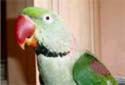
My alexandrine male parrot has got a red pinkish colour in his left eye, from the past two days he is just drowsy but eats food, he has a lot of pain and doesn't come in my hand. Please suggest me which drops to put in his eyes? Please I request you.

Click For Replies (1)
  • Clarice Brough - 2013-03-27
    The red/pink color could indicate conjunctivitis, or another eye problem. Usually red eyes are accompanied by the eye watering, often they will have respiratory problems as well. The bird should be quarantined from any other pets and taken to a vet for diagnosis. Most likely an antibiotic or antifungal treatments will be needed.
Reply

About Animal-World

Animal-World offers animal pictures, videos, and animal information on all different types of pets and animals. Included are animals that are commonly kept as pets, exotic pets and wild animals. Check us out for information, education, and fun. We strive to aid in responsible pet ownership and an understanding of the importance of preserving and honoring our world and its inhabitants. Animal-World members and contributors are from all over the world. You too are invited to be an active participant in this community. Post your own personal pet stories, contribute pictures of your pets, and join the forums for pet and animal discussions.

Visit Animal-World